Development of an online store in Ukraine in 2026: a strategy for creating a scalable and profitable B2C and B2B e-commerce system
In 2026, the Ukrainian e-commerce market demonstrates impressive adaptability. Despite the economic challenges, the sector is growing at a rate of more than 8% per year, and the share of marketplaces has exceeded 83%. For businesses, this means one thing: survival depends on the ability to build a flexible ecosystem that combines B2C service with powerful B2B tools.
Ship Stack
Platform for developers
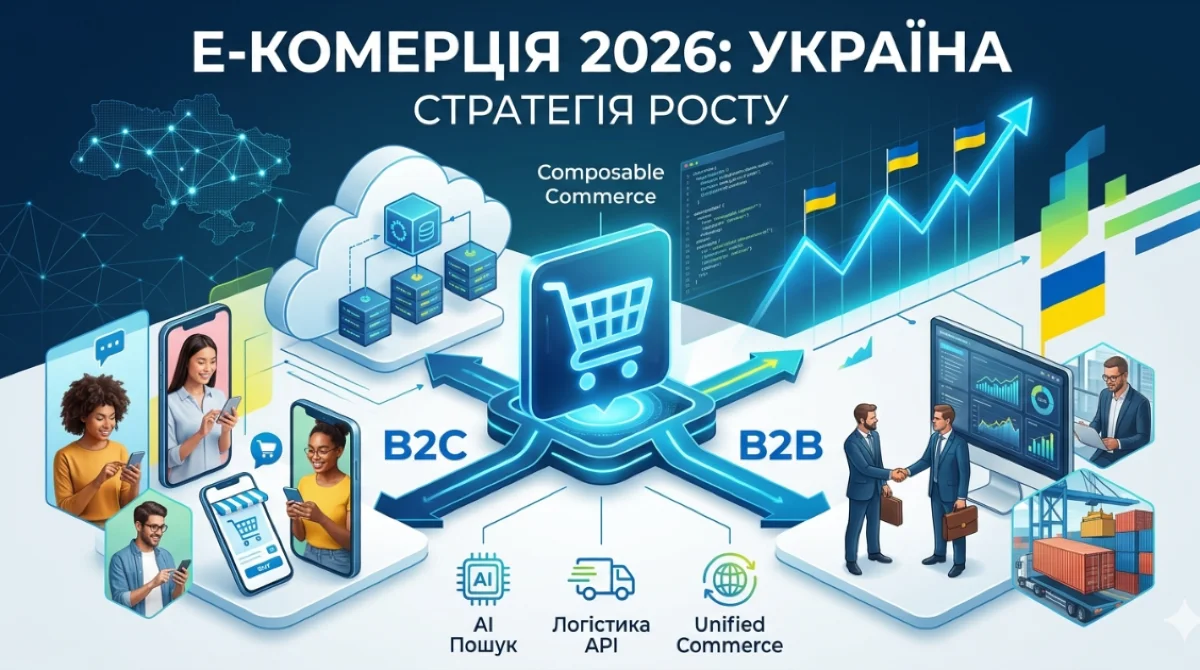
1. System architecture: Flexibility above all else
A modern store is not just a site, but a core to which dozens of services are connected. The best approach in 2026 is Composable Commerce(modular commerce).
Headless approach:Separation of frontend (design) from backend (logic). This allows you to change the site interface without the risk of "breaking" the database.
Unified Commerce:Integration of all sales channels (site, application, social networks, offline points) into a single database. The customer should see the same prices and balances everywhere.
Microservices:Each function (search, payment, shopping cart) works as a separate service. If the payment module "fails", the product catalog will continue to work.
2. B2C vs B2B: Two worlds in one system
Although the base of goods may be common, the logic of interaction with customers is radically different.
B2C (Retail) — Focus on emotion and speed
Mobile-First:Over 79% of traffic in Ukraine comes from mobile devices. The site should load in less than 2 seconds.
Frictionless Checkout:One-click payment via Apple Pay, Google Pay or local services. Each extra form in the cart reduces conversion by 10-15%.
GEO and AI search:Optimization for voice queries and AI search engines. The client wants to find the product by the query "dress for the evening in Kyiv", and not by precise filters.
B2B (Wholesale) — Focus on efficiency and loyalty
Personal offices:Ability to see individual prices, volume of discounts and history of reconciliation acts.
Automation of orders:"Repeat Pre-Order" feature and bulk SKU loading via Excel/API.
Roles and Access:The possibility for the client company to have several accounts (the manager forms a basket, the director confirms the payment).
3. Scaling through automation
In order for the business to bring profit, and not just "turnover", it is necessary to minimize manual labor.
Direction | Technology 2026 | Result |
Logistics | Integration with New Post API/Meest + WMS (warehouse management system) | Sending the order within 30 minutes after payment. |
Marketing | AI-personalization (SITNIKS CRM, HubSpot) | Automatic recommendations based on user behavior. |
Customer support | New generation AI chatbots | Closing 80% of typical questions (order status, availability) without human intervention. |
SEO | GEO (Generative Engine Optimization) | Optimizing content for answering in AI assistants. |
4. Local peculiarities of the Ukrainian market
Reliability of payments:Mandatory support of PRRO (software cash registers) and installments (Payment in installments).
Multilingualism:Full-fledged Ukrainian version as the main one (legal requirement and market norm).
Energy independence:Real-time balance synchronization is important because during blackouts or disruptions, logistics must run smoothly.
Summary: Where to start?
For a successful launch or redesign in 2026, start with an audit of your database. If your systems aren't "talking" to each other via an API, you're losing money on every order.